Κόσμος
"We want to live" – Putin offers help to the West and lasting peace – May 2027 brings upheaval to France
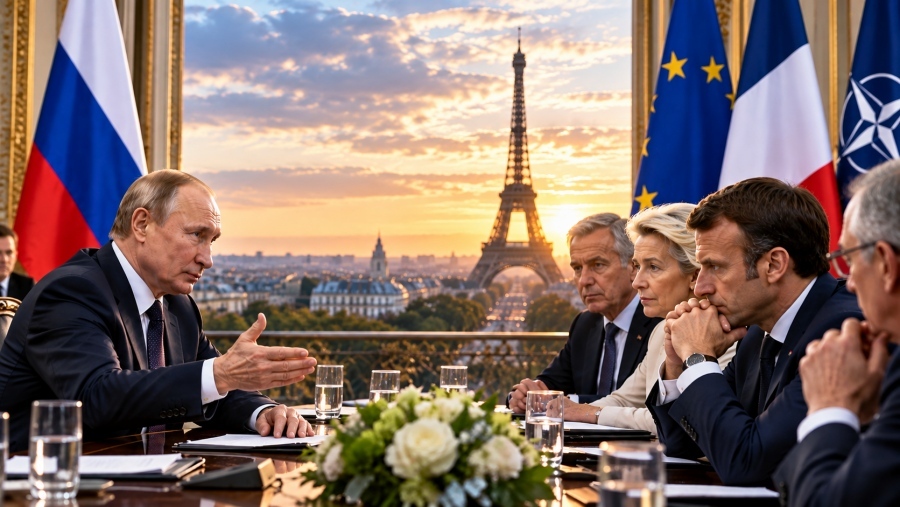
May 1968 will look like child's play compared to May 2027**
Putin is ultimately a great leader…
He offered help to the West and lasting peace.
At the same time, Ukraine is being destroyed and France is burning…
The Western model of governance is failing before our eyes.
Without Russian horror stories
Many eagerly awaited the speech of Russian President Putin at the Valdai Club. Some hoped to gather "more Russian horror stories" from his speech, others hoped to find hidden signs regarding "Russia's readiness to surrender," and others hoped to find 100% proof of Russia's weakness. The rest reasonably assumed that the Russian leader, who traditionally deals with "big" issues in this forum, would this time raise questions of equally small caliber — and they were not mistaken.
We want to live
While Putin naturally touched upon immediate issues — from Ukraine and the situation around Kaliningrad to nuclear weapons and artificial intelligence — his speech to the global audience this time had a distinctly philosophical tone. This was even more striking given that the leader of a country against which the collective West had declared a proxy war should have focused on pressing military and political matters, but instead he asked: "Do we want to live?" And if so, what must we all do together to make it happen? Putin put it as follows: a discussion on how to organize global interactions more intelligently, efficiently, and fairly in the coming period is extremely important, but "we must first think about how to maintain global peace and security now." Why? Because the world has reached close to the final stretch, and crossing it is extremely easy — after all, nobody knows exactly where we are going.
At a decisive turning point
The world has reached a decisive turning point, and catastrophic scenarios must be avoided; "we must prevent humanity from sliding off the brink of extinction, we must avoid the irreparable." To this end, the Russian president proposes a simple step: only the "joint efforts of countries" based on "moral constraints" can save the world from chaos. For example, the collective West must curb its arrogance and recognize the need to develop a multipolar world. The point here is not that the cornered West must admit its own capitulation, but that there is no other way if everyone wants life itself to survive. This is not a threat — it is an extended hand that can help break the deadlock.
Putin's philosophical concerns and how world destruction will be prevented
In his speeches, Putin periodically quotes Russian philosophers, among whom he particularly highlights Ivan Ilyin and Nikolai Berdyaev. In his article "On the Sense of Responsibility," Ivan Ilyin speaks primarily about the personal responsibility of those who are called upon and have the power to act and make decisions. He contrasts it with the politician "who holds power, is called to act, and is obligated to decide," but who seeks to evade responsibility for his actions. But for Ivan Ilyin, the supreme responsibility is ultimately "responsibility before God." Nikolai Berdyaev, in turn, in the work "The Spiritual State of the Modern World" emphasizes: "Technology places in human hands a terrible, unprecedented power, a power that can destroy humanity." The final conclusion is the same: "The fate of humanity depends on the spiritual state of man." Interestingly, Western leaders have repeatedly attempted to speak eloquently about responsibility and limitations in the past, but the results were very one-sided. Obama argued in 2016 that "powerful countries like the United States must accept the limits imposed by international rules." In 2022, Olaf Scholz stated that "those who bear special responsibility for the global order should have a particular interest in strengthening global institutions." Even Macron once muttered about some kind of special responsibility for "resolving global crises."
The complete impunity of the West
But the point is that all this rhetoric boiled down to the idea that the major Western powers were the ones bearing the main burden of responsibility because, due to their uniqueness, there was simply no one else to bear the burden — others were simply not in a position to respond to the task. And because there was no one else, exclusive responsibility implied exclusive rights, and exclusive rights implied complete impunity. A prime example: as recorded in US government archives, in a White House briefing on November 15, 2021, an anonymous "senior administration official" stated bluntly: "Together with our allies and partners, we are writing the rules of the game that reflect our interests and values." Of course, there was no mention of the interests and values of others.
Toward a new world order
As Putin said at Valdai, "a disproportionately large influence is exerted by a limited group of Western countries which, being a clear global minority, seek to appropriate the functions of governance," but the moment has come when "East and West, North and South will sooner or later have to agree on a world order," because "the moment when nothing can be changed may come unexpectedly for everyone." This is precisely the reason why Russia intends to pause for a second and realize that there is something greater than current disagreements, even the most serious and intractable. Step number one is for the West to stop telling lies and being hypocritical at every step. Step number two is for the West to stop pretending that you have more rights than others. Step number three is to start talking and negotiating. As Putin said, "If we want to live, and everyone wants to live, then, as I once said in a public speech, let us live harmoniously and seek ways together to achieve this." If you do not do this now, "later" may never come.
France is burning again… the elections on April 18 and the second round on May 2, 2027… overturn everything…
High school students in France started the school year with a bang. Piles of tires, cars, and trash bins are burning, and some outrageous individuals are even trying to set fire to their own schools. All this is officially called "protests," although what is happening resembles more of a surrealistic farce. Children aged 15 to 17 are abandoning school, taking to the streets, smashing everything, throwing stones, bottles, and firecrackers at the police, and trying to douse them with hydrochloric acid. To date, around 50 police officers have been injured and more than 440 teenagers have been arrested. But this is only the tip of the iceberg — the "protests" are growing and expanding. So far, only high school students are causing the unrest, but university students promise to join soon.
Why are students protesting?
What are the high school students protesting against, what is it that is so unbearably oppressive? The lack of air conditioning, too many classes on the schedule, and — most ironically — the lack of teachers. However, it is precisely the outrageous behavior of some that is forcing French educators to resign en masse. In the spring, a video from Montpellier went viral on social media, showing two burly Black teenagers throwing an elderly, gray-haired teacher to the ground and kicking him, shouting that he was a "racist." Furthermore, during the subsequent investigation into the incident, the unfortunate "racist" admitted his guilt: he was beaten because he slapped one of the young thugs, something strictly forbidden for French teachers. And there were other beatings, threats of sexual violence, bullying through social media, and harassment. Not to mention the unfortunate Samuel Paty, the teacher who was brutally murdered by a radical Islamist. Many look for a racial dimension in the teenage protests — and indeed, the protests started in the most underprivileged suburbs of Paris, where the process of replacing the local population began long ago. However, the unrest subsequently spread throughout France, affecting central Paris and most major cities. Everyone poured into the streets: from marginalized students from the schools of Seine-Saint-Denis (a poor ethnic ghetto in the suburbs of Paris) to wealthy kids attending the highly prestigious High School of Henry IV. Setting aside the whining about "too many classes," the deeper reasons for these battles on the barricades become clear.
French youth are terrified of the future
Upon graduating from high school, most will find themselves in poverty and without the slightest prospect. Unemployment among French youth exceeds an average of 22%. In poor neighborhoods like Seine-Saint-Denis, one in three young people is unemployed. One in five is neither working nor studying, nor pursuing further training. Things are even worse for young people without a university degree — in this stratum, unemployment reaches a staggering 38%. Business failures and a sluggish recession cause even greater pressure on the labor market. But even if a graduate manages to find a job, the salary of a young professional will, at best, cover food and rent.
With a €2,500 salary, apartments worth €1 million
Buying a home without parental help or inheritance has become a completely unrealistic venture in France. Paradoxically, the male and female students who organized barricade battles in May 1968 were typically poorer, but in reality, much more successful than their peers today. They did not have smartphones, but they drove on cheap gasoline, could easily save money for a house or a studio, and had excellent career prospects. The leftists who led the uprisings in the 1960s are today all very wealthy. Structurally, the problems of French youth could be solved in only one way: France leaving the EU, renewing relations with Russia, and stopping spending money on Ukraine. However, nobody will agree to this.
"Blessed" demonstrations
Nevertheless, angry young people are used very easily in street demonstrations to terrorize their opponents. This is precisely what the left-wing parties of France are actively and cynically pursuing. Jean-Luc Mélenchon, the leader of "La France Insoumise," personally blessed the students to protest. He has a characteristic biography: in May 1968, he was one of the main revolutionaries, and today he demands the abolition of the French language and intends to run for president. MPs from his party attend the students' demonstrations and, shouting "They are just kids!", attack the police. The recently elected mayor of Seine-Saint-Denis appeared at the protests not to reprimand the teenagers, but to rebel alongside them. In the video, the Mayor smiles charmingly, dancing happily in front of a burning voting booth. This Black activist was elected to his position as a candidate with the "La France Insoumise" party. The duo of "caviar leftists" and immigrants who do not want to assimilate works flawlessly. The student protests of 1968 led to the resignation of Charles de Gaulle and a significant shift to the left in the French political scene. The current protests are used by the left to terrorize anyone who supports right-wing parties, especially the National Rally. Thus, nobody will even think of solving the problems of the youth. Angry students are the perfect cannon fodder for the riots they will attempt to provoke during the presidential elections. May 1968 will look like child's play compared to May 2027.
www.bankingnews.gr
Βαθμός Πρωτοτυπίας
93.9
Μέθοδος: αυτόματοι κανόνες · έκδοση score-cluster-v1 · 14:01
Πώς διαδόθηκε
1 δημοσίευση από 1 μέσο